
The Sunday Goldmine: How Your Sermons Can Reach More People All Week Long
There is a goldmine sitting inside your church right now.
It’s hidden in plain sight, likely tucked away in a digital corner you’ve grown so used to that you’ve stopped seeing its value. I’m talking about your sermons. Specifically, those dozens, perhaps hundreds, of hours of life-changing teaching currently gathering digital dust on your YouTube channel.
Does this sound familiar? You spend twenty hours a week in prayer, study, and sermon prep. You pour your heart out on Sunday morning. You witness the nods of realization in the pews. Then, by Monday afternoon, that message is uploaded to YouTube, a few people watch the replay, and by Wednesday, it’s buried under an avalanche of cat videos, political rants, and the latest viral trends.
Your best content is disappearing.
It’s a tragedy of stewardship. We wouldn’t spend thousands of dollars on a beautiful physical library and then lock the doors six days a week, so why do we treat our digital teaching the same way?
The DIY Path: Could You Do This Yourself?
Absolutely. You could do this yourself.
You could download each sermon video, run it through transcription software, clean up the rough transcript, reshape it into a readable blog post, research SEO keywords, upload it to your website, write social captions, and manually publish every piece across your channels.
For a week or two, that might even feel manageable.
But here’s the catch: the work is real, and the grind is relentless.
Ministry does not slow down just because your content workflow got more complicated. Hospital visits still happen. Counseling appointments still fill the calendar. Staff fires still need to be put out. Sunday is always coming. So while the DIY route is possible, "figuring out the tools" and then maintaining the weekly implementation usually starts stealing time from the work only you can do.
That’s the uncomfortable truth.
What starts as a smart stewardship idea can quietly become another full-time job. And instead of creating more impact, it creates another layer of pressure, another unfinished checklist, and eventually, burnout.
If you are a DIY-minded pastor, you are not wrong for wanting to build it yourself. But you do need to count the cost. The question is not just, "Can we do this?" The real question is, "Can we do this consistently without pulling ourselves away from actual pastoring?"
The "YouTube Graveyard" Crisis
We need to talk about the "YouTube Graveyard." It’s an uncomfortable truth: for the average church, YouTube is where great sermons go to be forgotten.
While the platform is an incredible tool for streaming, it is not a filing cabinet. It is not an archive designed for your congregation’s deep study. And it certainly isn't optimized to help a hurting person in your city find your specific biblical wisdom when they search Google for "how to fix my marriage" at 2 AM.
If your sermons only live as video links, they are nearly impossible to search, difficult to navigate, and incredibly easy for the algorithm to ignore. You are building your ministry's intellectual and spiritual property on "rented land" in a digital rainforest that is constantly trying to overgrow your path.
Is your Sunday message actually reaching the people who need it on Tuesday?
Stewardship vs. Marketing: A Holy Distinction
I know the word "marketing" makes some ministry leaders wince. It feels transactional. It feels secular. But let’s reframe the conversation.
If you believe the Word of God is transformative, then getting that Word in front of as many people as possible isn't "sales", it’s stewardship. It is the modern equivalent of Paul standing on Mars Hill. He didn't wait for the Athenians to stumble into a synagogue; he went to the places where they were already gathered and spoke their language.
Today, those "hillsides" are Google search results and social media feeds.
By repurposing your sermon, you aren't just "creating content." You are creating doorways. Every blog post, every social clip, and every email recap is a new entrance to your church for someone who might never have walked through your physical doors.
Turning the "One-and-Done" Into a Living Library
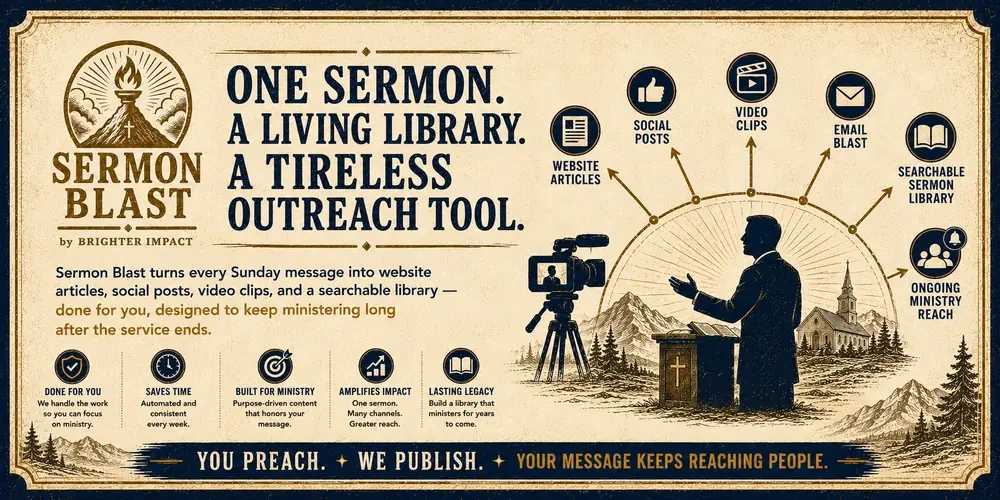
The goal of a Sermon Blast strategy is to move from a chronological feed to a searchable library.
Think about the specific needs in your community. Someone is struggling with anxiety. Someone else is mourning a loss. A young couple is looking for guidance on parenting. You’ve preached on all of these topics. But can those people find your teaching?
### The Power of Searchability
When you turn a YouTube video into a polished, indexed article on your website, something magical happens: Google can finally read it.
Search engines are excellent at reading text but notoriously mediocre at "watching" videos to understand nuance. By transcribing and formatting your sermon into a blog post, complete with Scripture references, key takeaways, and headers, you are essentially handing Google a map to your ministry.
* Myth: "If I post the video, people will find it."
* Reality: Unless they know your church name, they won't. People search for answers, not organizations.
By creating a searchable archive, you ensure that when someone in your city Googles "what the Bible says about forgiveness," your pastor’s voice is the one that meets them in their moment of need.

You Preach, We Publish: The Magic of Automation
The biggest hurdle for any church is time. You are already spread thin between pastoral care, staff meetings, and sermon prep. The idea of "repurposing content" sounds like another forty-hour-a-week job you don't have the budget for.
This is where the shift happens. At [Brighter Impact](https://www.brighterimpact.net), we believe you should focus on the ministry while technology handles the machinery.
Imagine a world where your Monday morning doesn't involve a content scramble. Instead, the system works in the background:
1. Sunday: You preach. The video goes to YouTube.
2. Monday: Our system pulls the video, transcribes it, and drafts a polished article.
3. Tuesday: That article is published to your site, optimized for SEO, and formatted for readability.
4. Wednesday: A "Mid-Week Touchpoint" email goes out to your congregation with the key takeaways.
5. Thursday/Friday: Short, "snackable" video clips land on Reels and TikTok to reach the next generation.
This isn't a dream; it’s a standard Sermon Blast workflow. It takes the burden of "digital management" off your team so you can get back to what you were actually called to do: shepherd people.
## Why "Good Enough" is Killing Your Reach
We often settle for "good enough" in our digital presence. We think, "Well, at least the video is online."
But "good enough" is why pews are graying and reach is plateauing. The digital world has raised the bar. People expect high-quality, accessible, and mobile-friendly content. If your website is just a static list of dates and times, you are effectively invisible to anyone under the age of 40.
Consistent, high-value content signals life. It tells a seeker that your church is active, relevant, and thinking about the same questions they are. It builds trust before they ever shake your hand.
Reaching the "Sunday-Only" Seeker
We also have to consider our own members. Life is busy. People miss Sundays. Even those who are there can only retain about 10% of what they heard by Tuesday.
A sermon library serves as a discipleship tool. It allows your members to revisit a point that touched them, share a specific quote with a friend in need, or catch up on a series they missed during vacation. You are extending the "shelf-life" of the Word from 40 minutes on Sunday to 24/7 access all year long.

The Vision: A Digital Great Commission
We are living in an era where the "ends of the earth" are accessible through a glass screen in every pocket. We have been handed the most powerful communication tools in human history. To leave our best teaching locked in a 45-minute video that no one can find is a missed opportunity of biblical proportions.
Your sermons are more than just speeches; they are seeds. But seeds can’t grow if they stay in the bag. You have to scatter them. You have to plant them in the fertile soil of the internet where people are actually looking for hope.
Are you ready to stop letting your sermons disappear?
It’s time to unlock the goldmine. It’s time to ensure that the hours you spend in study continue to bear fruit long after the "Amen" is spoken.
Don't let another Sunday go by where your message has an expiration date. Give your sermons the second life they deserve.
Next Steps for Your Ministry:
* Audit your archive: Look at your YouTube channel. How many videos have fewer than 50 views? Those are missed opportunities.
* Think Search-First: Start titling your sermons based on what people search for, not just catchy metaphors.
* Automate the Workload: Explore how [Sermon Blast](https://www.brighterimpact.net/sermon-blast) can handle the publishing for you so you can stay focused on your calling.
The message is sacred. The method is just a tool. Let’s use the tools we have to make sure the message is heard.
***
